
Been-there
Falkland Islands
JOURNAL:

All photos: © Andrea Kline
King of My Penguin Dreams
Are you even real, Falkland Islands? I have vivid memories and a lot of photos, but you came and went like the sweetest of dreams.
After two and a half glorious days along the Antarctic Peninsula (plus four days in the Drake Passage) — it had been more than six days since my feet had touched land in Ushuaia. I can get a little restless in confined space, especially when I'm on someone else's schedule, so I was really looking forward to arriving in Port Stanley, in the Falkland Islands. The ship anchored in the harbor and then cruise passengers lined up to board tender boats that took us into town. It was 4:30 a.m., dark, rainy, and cold. Despite all that, I fell for this place quickly and completely. But allow me to nerd out about rocks for a minute first.
This tiny British territory off the coast of southern Argentina is overflowing with beautiful landscapes and abundant marine life. The archipelago has two main islands (East Falkland and West Falkland — thanks for keeping it easy, bruh!) and approximately 775 smaller islands surrounding them. Geologists have determined that these islands were once part of southeastern Africa, eventually drifting westward with the tectonic plate we now know as South America. Another fun fact is that during the last ice age, rivers of rocks (called "stone runs") were formed by the repeated freezing and thawing of quartzite that, over time, tumbled downhill like streams of water. They remain in place today, and were something I'd never seen before. I found them fascinating.
Before this trip, I read articles and watched videos about the Falklands and what there is to do and see there. The territory has a rough history, including a fairly recent war (1982) between the United Kingdom and Argentina over control of the land, and access to the oil offshore. The UK won that battle, but some level of animosity seemed to still exist. The divide was clear when talking with other cruise passengers: The British tourists wanted to see Stanley and the island's wildlife, while the Argentine tourists wanted to see the battlefields and visit cemeteries. I wish I'd known more about the conflict while I was there to better appreciate the importance of this set of rocks in the South Atlantic Ocean.
My only goal that day was to see penguins. There are more penguins in the Falklands than people, so I knew I was in store for a memorable day. The cruise line offered a few [high-priced] excursions to areas known for a moderate number of penguin colonies close to the port, mostly populated with small Magellanic and Gentoo varieties, among others. But my favorite is the big, bad King penguin — the ones with yellow/orange on their heads and chests — and the Falklands is home to some of the world's largest colonies. The cruise line didn't offer a tour there, but I was determined to get my a$s to a place called Volunteer Point.
I found a local company with exactly the tour I wanted on the Falkland Island's main tourism website, which is the preferred place to purchase tours from local vendors, but you have get your ticket as early as you can. Only a certain number of vehicles are permitted to traverse certain parts of the islands each day (private property with no public roads), meaning there were only so many seats available. After contacting two companies, the third had ONE ticket remaining, and it was mine.
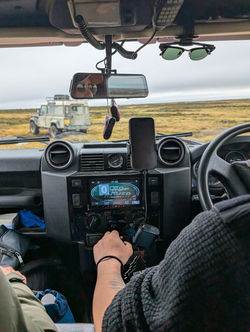
Volunteer Point is located along the northern coast of East Falkland Island. The land is privately owned by a family of generational sheep farmers — the Johnsons, if you must know! — and has no road beyond their driveway. The family is in the process of building a road, but it's been slow-going since they have to fund it themselves. So, for now, the only way to get there is by off-roading in a 4x4 vehicle with an experienced driver — two jarring hours from Stanley and then two jarring hours back. When I say "off-road" and "jarring," I mean across soggy bogs, over large rocks, and through fresh mud. I mean one hand to grip the seat in front of you and the other to brace yourself against the ceiling. I mean get comfortable being bounced onto your neighbor's lap, and for them to end up on yours. In other words: Let's goooooo!
I was one of four passengers in a 4x4 truck — one person sat in the front with our driver, David, and three in the back. I didn't know the others, and it didn't matter. Somehow I ended up in the middle of the backseat. Great views out the windshield, though, when I wasn't being body-slammed by the ladies on either side of me. We all laughed at how ridiculous it was, and cheered for David when he really sent us flying, which made him laugh, too. It was a blast!
Upon arrival at Volunteer Point, every 4x4 had to stop at a checkpoint where all humans had to sanitize our shoes. That meant unloading from the vehicles and stepping into a shallow tray of sanitizing liquid that helped eliminate the chance of us bringing anything harmful to the penguins and other wildlife. After that, we loaded back into the vehicle and made our way to a small parking area. We had three whole hours to explore, observe, and walk among the penguins.
There were a handful of workers in neon yellow vests reminding all tourists that this land belongs to the animals: It's their home and we needed to behave accordingly. You could go left toward the beach, or right toward the penguin colonies. Most of the people went right, so that meant I was going left. I could see the beach about 200 yards away, and as I got closer and closer, I was looking at one of the prettiest beaches I have ever seen. Pale green water, rough surf, and windblown white sand with penguin burrows and webbed footprints as far as the eye could see. It seemed so wild and untouched, even though I was there on a tour. We could take all the photos we wanted, but had to stay at least five meters away from penguins.
I walked up and down the beach a few times, watching groups of about a dozen penguins at a time pop out of the sea and onto the sand, and other groups diving back into the waves. There was quite a bit of traffic, and it was unreal to be seeing it in person, like I was filming a National Geographic documentary with my eyeballs.
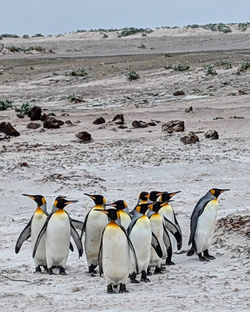
I didn't want to leave the beach, but since my time was limited, I needed to make my way up over the hill to see the colonies. The walk was about 400 meters, over one small hill and across a narrow stream before up a second hill ... and then there it was: A large patch of dirt FILLED with King penguins — hundreds and hundreds of them! I could see, hear, and smell them, and it was absolutely incredible. I know you're curious, and no, the smell wasn't awful. I also grew up on a farm, so I might be less sensitive to those things. Anyway, the penguins were chatty and busy. There were dozens and dozens of ugly-cute brown, fuzzy babies, too.
Here, flat stones formed a large circle in the dirt. Humans had to stay outside of the circle, and the penguins could go in or out, and wherever else they wanted. The yellow-vested workers stationed here had different instructions: Penguins will approach you, so stay still, and be quiet — do not touch them, do not startle them. Everyone minded the rules and I watched the penguins socialize, care for their babies, quibble with their friends, and waddle right up to me. They were curious creatures, cocking their heads left and right to check me out. King penguins are the second-largest breed, and these ranged in height from two feet-ish to nearly four feet tall.
Unfortunately, my time with the penguins was winding down and I needed to make my way back to the parking area and find David. It was hard to leave the colony — I knew how unlikely it is for me to see anything like that again. The other passengers were already standing at David's 4x4, so we piled in and headed back into the wilderness. We talked about what we had just experienced, and watched David help another 4x4 get unstuck from the mud. Soon we found our way back to pavement.
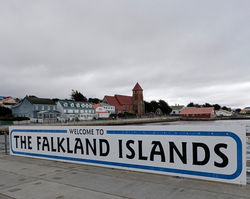
David got us back to Stanley with enough time to walk the "main drag," essentially the entire length of the town. There are fewer than 3,000 residents, a busy port, a couple of pubs, a post office, a grocery store, a few souvenir shops, old red phone booths common in the UK, an outdoor whaling exhibit, a wartime museum, a church, and a gazebo made of two sets of whale jawbones in the church courtyard.
At the port, I got in line to board a tender boat to go back to the cruise ship. One day was not enough in this lovely and lively little town. There are so many other coastlines to explore, with whales, dolphins, elephant seals, sea lions, albatross, and more. This surprising slice of Britain in the South Atlantic felt like an illusion, a gift. Truly a dream come true.
_______________
A FEW OF MY PHOTOS:
 |  |  |
|---|---|---|
 |  |  |
 |  |  |
 |  |  |
 |  |  |
 |  |  |
 |  |  |
 |  |  |
 |  |  |
 |  |  |