
Been-there
Ushuaia
JOURNAL:

All photos: © Andrea Kline
THE END OF THE WORLD
If your first reaction to hearing Ushuaia is "Bless you!" — come with me for a minute.
Let's try this: you-SHWHY-ya. You got it!
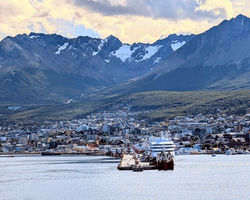
Going to Ushuaia, Argentina, is a bit like going to the moon — um, I'm guessing, of course. The city at the very bottom tip of South America gives serious “Wow, I can't believe I'm here” energy. My 38-hour journey from the Midwest involved flights and layovers in Chicago, Bogota, and Buenos Aires before finally landing in Ushuaia. By the way, the airport is right in town, tucked in between mountains, and just feet away from water. Not to mention that the weather might welcome you with sideways rain and a cold blast of wind, followed by sunshine and a rainbow — all within 10 minutes. But one doesn't go to the End of the World for predictability.
Despite the effort, or maybe because of it, Ushuaia delivers B-I-G on rugged beauty, raw adventure, and wildlife that pays no attention to the growing number of human onlookers. And that’s exactly the point.
Ushuaia is also a busy port city and popular launch pad (see what I did there?) for passenger cruises and research expeditions to Antarctica. That's why I went to Ushuaia. I spent 4 days there before boarding a cruise ship headed to the Antarctic Peninsula, and even though the cruise was amazing, I would have been content to spend my entire month-long trip in this area of Patagonia.
I stayed at the Hotel Canal Beagle, a lovely hotel near the port and named for the Beagle Channel that opens to the south of Ushuaia in the Tierra del Fuego region and empties into the Drake Passage — the gateway to Antarctica.
After 38 hours without sleep, I somehow checked into my hotel and caught a serious second or third (or fourth? fifth?) wind, washed my face, brushed my teeth, unpacked part of my bag, and hit the streets. It was also about 3 p.m., so I had to do something until it was an appropriate time to finally go to bed. In my pre-trip research and because I love to study maps, I knew there was a large "Ushuaia" sign along the water, so I headed that direction. There was sun, there was rain, there was wind in the 15-minute jaunt to the sign. I walked back toward the pier and saw the ships in the port. Mine hadn't arrived yet, since I wasn't set to board for 4 more days.
Ushuaia is a surprisingly cute town. Very tourist-friendly [there's a Hard Rock Cafe, and no, I didn't go in], compact, and the streets are organized in a simple grid that made it easy to find my way around. I walked up and down the main streets, making mental notes of where I wanted to return in the coming days. Now, however, the exhaustion was setting in (I had arrived at the end of the world, after all!). Back at my hotel, I unpacked the necessities, took a shower, ordered a sandwich, and was asleep before my head hit the pillow.
The next morning, I received a message that my planned day trip into Tierra del Fuego National Park with a local company had been canceled. Did I let it change my plans? Nope. I went to the Tourism Office that I had spied the day before that was a few blocks from my hotel. Staff directed me to the shuttle bus office another couple of blocks away. The "office" was about the size of my bathroom (i.e., the opposite of large), with four staffers and dozens of travelers/tourists bouncing around inside. In Spanish only, I learned there was a public shuttle bus to the national park, with different stops included with differently priced tickets. Each stop had preset drop-off/pickup times. I bought the full ticket (for the bus and entrance to the park), which cost about $20. I found a seat next to a French couple and then the bus left Ushuaia and headed into the forest toward the park.
Tierra del Fuego Region & National Park
"Tierra del Fuego" means "Land of Fire" — It's believed that in 1520, Spanish explorer Ferdinand Magellan saw multiple fires dotting the landscape as he and his crew sailed into the bay and found several established communities of native peoples. It is also the name of the region comprising southern Argentina, and is known for its unique combination of marine, forest, and mountain ecosystems. It is Argentinian Patagonia at its finest and most dramatic: mossy, fern-filled forests; sparkling glacial lakes and rivers; and breathtaking views. The Tierra del Fuego National Park is a must-see if you ever find yourself in this part of the world, if it's not one of the main reasons you make the journey.
The shuttle bus stopped first at Bahía Ensenada Zaratiegui — Ensenada Bay — and I hopped off. The pocket-sized map that came with my bus ticket was in Spanish only, so it took a minute for me to understand that this bay was also home to the southernmost post office on the planet. I went inside but didn't mail anything. The slate rocks along the shore looked like they had spilled out the side of the mountains.
I walked the length of the bay and discovered a trailhead sign. It was the Senda Costera ("Coastal Trail"), and in Spanish I could make out "8 kilometers," "4 hours," and "moderate." Okay, let's do this! I started down the trail, which mostly hugged the coast with dips and climbs through the inland hills. Again, there was rain, there was wind, there was sunshine, and there was a rainbow. It's a popular trail, so there was always someone within earshot. I felt confident help was close if I needed it, but was also on my own enough to really experience the park — and not have an audience when I occasionally slipped in the mud.
I popped out of the forest near the Alakush Visitor Center, located on the shore of Lago Roca ("Rock Lake"). This was the spot where I took a celebratory selfie after completing the hike. I also enjoyed a coffee and alfajores de chocolate while meandering through the Center's exhibit on native people, plants, and animals.
The last preset pickup time for that day's shuttle bus came and went. That might have made me nervous if I hadn't been "stranded" in such a stunning place. An hour or so late, the bus showed up and about a dozen park visitors were taken back to Ushuaia. I walked a few blocks to knock the mud off my shoes and settled into a cafe for the best empanadas I'd ever had. Back at the hotel, I spent the next two hours in a hot tub. Pretty much a perfect day.
Fuegian Lakes & Lamb
The next day began with an 8 a.m. pickup. An older Argentine couple and I got into Veronica's car and the four of us hit the highway. Arranged through my hotel, Veronica was a local guide who takes small groups to see a few of the mountain lakes, complete with jaw-dropping views of the Southern Andes and a meal of traditional Argentinian cordero al asador ("spit-roasted lamb"). Between the lake views and meal, we made a stop at the end of the Pan-American Highway, which begins in Alaska and ends in — you guessed it: Tierra del Fuego. We made our way to a winter lodge in a gorgeous mountain valley, and I could smell the barbecue pit before I got out of the car. Now, who's hungry? The pile of meat offered would have fed a small army, and I was able to put my fork down in time to enjoy a bombon dessert of chocolate cake filled with ice cream and caramel and then dipped in chocolate. Back in Ushuaia, I walked off some of it and popped into several shops along main street. I bought my usual souvenirs: a book and a map. No dinner needed, just a sunset from the town square. So yeah, another pretty perfect day.
The Beagle Channel
Multiple catamaran tour operators can be found in booths near the pier, taking visitors into the Beagle Channel and out to one of the southernmost lighthouses in the world (Les Eclaireurs Lighthouse) — and that's how I spent my last day in Ushuaia. This legendary waterway is flanked by snow-capped mountains and dotted with rocky islands overloaded with wildlife. A herd of sea lions sang and sunbathed on the rocks, flocks of cormorants pretended to be penguins, and albatross birds with 10-ft wingspans gracefully swooped overhead and downward, effortlessly gliding just an inch or so above the water.
THE BEST OF THE REST
There is a lot more to do in and around Ushuaia, much of which I wasn't able to fit into my too-brief stop in this wild wonderland. Here's a short summary of other top attractions.
The End of the World Train
This charming little train used to haul prisoners to work in the forest. Now, it hauls tourists through some truly epic scenery around the Tierra del Fuego region. It’s a short, scenic ride that seems like a good option for kids.
Maritime & Prison Museum
Ushuaia had a "wild west" reputation because the region's most violent criminals were housed in the town's old prison, which was built by the prisoners themselves. It's now a museum that covers everything from shipwrecks to polar exploration to the bleak daily life of its inmates. It's said to be weirdly fascinating and a great way to spend a rainy afternoon.
Penguins on Isla Martillo
On this tour that can be booked in a booth at the pier, you can literally walk with penguins. For a fairly hefty price, you can roam among dozens, even hundreds, of tuxedoed birds waddling around like they own the place — because they do.
Climb Martial Glacier
Just above town, this glacier offers a short, steep hike with rewarding views of Ushuaia and the Beagle Channel. In winter, it doubles as a ski area.
Fin del Mundo Museum
More quirky and compact than the prison museum, this local favorite explores the culture and natural history of the region. Learn about Fuegian indigenous tribes, early explorers, and even see a creepy two-headed lamb.
4x4 Off-Roading
Something I did often as a kid has become one of my favorite activities while traveling: 4x4/ATV off-roading tours. If you're in Patagonia, why not see the terrain from a 4x4 while splashing through rivers and barreling down dirt roads? These tours from Ushuaia often go deep into the wilderness and include lunch with traditional Argentine mate tea.
Ending Thoughts About the End of the World
It isn’t just a far-flung destination. Ushuaia’s kind of a bragging right, definitely an adventure badge, and a love letter to the wilderness all rolled into one. Yes, it’s a haul. But once you’re there, devouring empanadas and sipping a craft beer or glass of Malbec with a view of the Beagle Channel, you’ll be glad you came.
Ushuaia is my kind of vibe: near water, at the base of a mountain range, close to dense forest, in a cool climate, with a surprising abundance of wildlife, and lots of relaxed and friendly folks who seem to understand and appreciate the beauty surrounding them. The locals' secret is out: They know they're special, and now, so do I.
_______________
A FEW OF MY PHOTOS:
 |  |  |
|---|---|---|
 |  |  |
 |  |  |
 |  |  |
 |  |  |
 |  |  |
 |  |