
Been-there
Santorini
JOURNAL:

All photos: © Andrea Kline
"You're Still Here?"
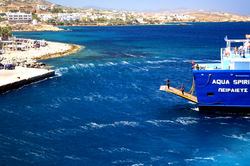
After an amazing week in Athens, I boarded a ferry in the suburb of Piraeus to sail south on the Aegean Sea to Santorini. The boat was equipped with a parking garage, bars, restaurants, shops, and multiple decks with indoor and outdoor seating. It dropped off and picked up passengers at the islands of Paros, Naxos, and Ios before reaching Santorini. This was the "regular" ferry, not the high-speed one — why would anyone want to speed through this kind of scenery?! — and it took about eight hours to arrive. Pro tip: Ferries are an inexpensive, efficient, and comfortable way to create a custom island-hopping itinerary.
If you've ever been to or heard of Santorini, you know that a volcano erupted around 1630 B.C. and blew the place to smithereens. As a result, the island is now a semi-circle of land with the volcano's eye in the center (called Nea Kameni). There are steep cliffs (the caldera) that were created by the blast on one side, and land that slopes gently down to the sea with gorgeous beaches on the other side.
Villages dot all areas of the island, but the main attraction is Fira — or Thira, or Thera, depending on what your map says. I found that towns throughout Greece used multiple spellings, which made editor Andrea's brain hurt, but linguistically-curious Andrea's ears perk up. Greek has its own alphabet, and English is derived mostly from Germanic language but uses the Latin alphabet. I learned that the variations in spellings occur because mixes of Greek, Germanic, and Latin produce varying results, so there are no universally accepted rules for transliteration from Greek to English. Ok, that makes sense and is absolutely fascinating! Anyway, Fira/Thira/Thera is the capital Santorini, and is perched atop the western cliffs. The top thing to do here is to watch the sunset. That sounds silly, but you'll see.
A Santorini Celebrity
Santorini is a very popular stop for cruise ships, and I saw the manic hustle and bustle of a port city firsthand. I had never thought about the cyclical lives of those who live and work in one of the world's busiest cruise port cities. A couple days of loud and crazy crowds, followed by a couple days of quiet stillness, and then it all begins again. For many residents, tourism is all they've known — born into a tourism-related family business or having had some type of hospitality job since they were teens.
This made my three-week stay unusual and confusing for the locals. They were a very friendly bunch, those Santorinians, and in Week 1, everyone greeted me with a smile, a wave, and a "Hello!" as I explored their island. By Week 2, many would do a double-take when I walked by, wondering if a cruise ship had left without me. By Week 3, multiple shop owners would turn their palms upward, smile, and ask, "You're still here?" They weren't accustomed to seeing the same tourist for weeks, and it made me laugh. I was being "recognized" all over town! "Yes," I would reply, palms turned upward, "Why would I leave such a beautiful place?"
Just for fun: How many cruise ships can you spot in my photos below? They were everywhere!
Treated Like a Queen at King Thiras Hotel
My initial plans for Santorini fell through at the last minute — my original hotel had overbooked and then canceled my reservation the day before I was set to arrive. There were others with vacancies, but I had to choose fast. I clicked "Submit" on a booking site and hoped for the best. And that is exactly what I got. The BEST. It was kismet, really.
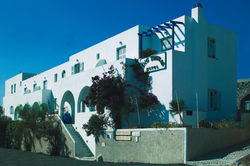
I arrived at King Theras Hotel from the port by taxi, and was greeted with a bottle of water and a hug from husband-and-wife owners, Emmanouel and Koula. My room was basic but spotless, very comfortable, and came with a view of the Aegean Sea. Emmanouel ran the reservation desk and did the "business" stuff, while Koula prepared and served the daily breakfast, and managed a small cleaning staff. Beyond their expected duties as innkeepers, they went went out of their way to make sure I felt welcome. Let me share a few examples.
One hot afternoon I was walking back to the hotel from the bus station after a day at the beach when Emmanouel drove by. He honked, waved, and pulled over to ask if I wanted to ride along as he taxied hotel guests to the port. Why not? I jumped in and we dropped the couple off at the pier. Then we ran a few errands — to a tiny traditional bakery for more breakfast bread, and an "emergency yogurt run" at a local supermarket.
Emmanouel and Koula lived in the lower level of the hotel, so they were always around to greet guests as they came and went throughout the day. One of those days, they greeted me as I returned from Old Town Fira and headed to my room. About 20 minutes later, my room phone rang. It was Koula, inviting me to have a glass of wine with her and Emmanouel. "Yes! I'll be down in a few minutes!" When I got there, Koula had planned a small dinner party with a few of their friends, and wanted to include me. We shared wine, fresh fish, tomato salad, bread, and olives. They humored me by speaking in English, and answered my curious questions about Santorini. It was wonderful!
Another day, I woke up with a head cold and let Koula know I wouldn't be down for breakfast. A few minutes later, Emmanouel was at my door to ask if I was OK and if I needed a ride to a pharmacy for medicine. Who does that?! Emmanouel even invited me to his family's Name Day celebration, which is an intimate event considered much more important than a person's birthday. I accepted his invitation, attended a service in his tiny family chapel, and was fed the most incredible Greek meal by his extended family. And I was welcomed with [literally] open arms at every turn. I'll write more about that experience another time.
Emmanouel and Koula would make it difficult to leave after my stay. They'd have new guests to greet and feed and care for, but I felt like I was leaving friends behind. They made my time on Santorini truly special.
Exploring the Volcano
I must have a thing for volcanoes. First Iceland, then Hawaii, then Greece. Maybe it's because I'm a to-the-letter, fire-sign Sagittarius. Maybe it's because they're such an awesome force of nature or because their landscapes look like the surface of the moon. Who knows ... what I do know is that volcanoes are cool — when they're being cool — and I like to see them up close.
Side note: I was already planning to do the popular All-Day Volcano Tour, and was surprised one day at breakfast when my innkeepers handed me a ticket and said, "Here, this one's on us. Go enjoy our island." Seriously. The. Nicest. People.
The tour departed from the Old Port of Fira, which is different from the new port (Athinios Port) where I landed upon arrival from Athens. The old port is — um — older, and is where local small-boat excursions depart and return. It's also the place where you can take the 587 stairs down to the pier, hitch a ride on a traditional donkey (please don't choose the donkeys, they're SO overworked!), or take the cable car. I got a roundtrip ticket for the cable car.
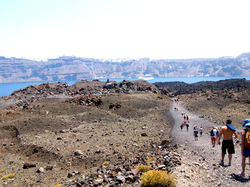
This tour consisted of five stops. The first was at Nea Kameni, the volcano's eye. There were walking paths on loose gravel, and no barriers along the edges of the vents and craters. I hiked to the top for a 360-degree view of Santorini. The next stop was the hot springs, heated by the lava below. The guide said the springs were no longer terribly hot, but because of the high iron content, the red water would stain light-colored bathing suits. Oh, and if you wanted to swim, you had to jump off the boat. So ... I jumped! The third stop — the island of Thirasia — had a couple of restaurants and not much else. I mean, it had the view, of course, and I was eating souvlaki in a volcano, which was awesome. Next was Oia (pronounced: EE-ah) to drop off passengers staying there. It's a picturesque town on the northern side of the island known for its shopping and expensive resorts. The last stop was where I'd started, the Old Port of Fira.
It was the kind of day I'd dreamed about having in Greece: It had a volcano, fun, sun, learning, hiking, swimming, hot springs, meat on a stick, cable cars, lava rocks, and tan men in Speedos — all made possible by the generosity of my innkeepers.
Life Before the Last Eruption — The Ruins of Akrotiri
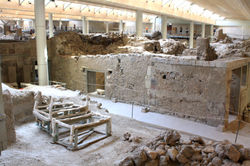
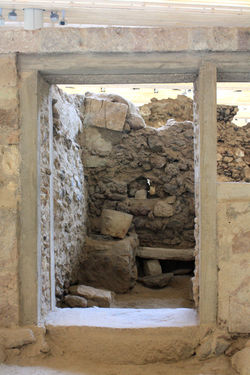
"But what was it like before the blast, Andrea?" Funny you should ask! The ancient Minoan city of Akrotiri (pronounced: ah-krow-TEER-ee) was a busy trading hub in the Aegean Sea between modern-day Turkey/Middle East and Northern Africa. It's located on the southwestern end of Santorini and was buried under volcanic ash during the eruption of 1630 B.C. Because of the ash, the city has been remarkably preserved — much like Pompeii in Italy, except that the people of Pompeii didn't have much time to evacuate, and scores of people and animals perished. Akrotiri residents fled after multiple earthquakes severely damaged their city. No human remains have been found here, indicating that the people abandoned the town long before it was destroyed. What they left behind were all of the things that described their everyday lives: cooking and crafting tools, dishes, wine vessels, bathing tubs, plumbing methods, pottery, and several impressive wall paintings — all found inside otherwise empty homes. Incredibly, archaeologists believe only 5% of the city has been uncovered.
Many of the buildings at the site were three stories tall, apparently uncommon for cities founded around 4500 B.C. Residents created a cement-like substance with saltwater, clay, and straw, and used it to build the walls of their buildings. Corners, door/window openings, and some building fronts where faced with ashlar stone, a stone that was easily shaped and smoothed to make visible surfaces more attractive. It was quite fragile, though, and didn't fare well during earthquakes.
The smoothed flooring shown in my photos is packed volcanic ash that hasn't been excavated. One of the guides said that the stones are naturally black/gray, but they appear beige because they're still covered in ash and dust.
It's unclear how the townspeople collected fresh water — even today fresh water on Santorini is an issue. Still, the Minoans had extremely sophisticated plumbing systems made of clay pipes that were built into the walls, connecting to toilet rooms in almost every home. It's one of the first known instances of "indoor plumbing."
Archaeologists have determined that Akrotiri was a wealthy port city that regularly traded with Crete, Egypt, Syria, Cyprus, and the Greek mainland. They've found weaving tools and pottery studios that suggest items were "mass produced" and then exported.
A fascinating site, and I highly recommend it if you find yourself on Santorini with more time than a cruise itinerary usually allows.
Circling the Island On An ATV
Before I arrived, I had read that 4-wheelers (a.k.a. ATVs or quads) were a popular way to see the island. Once I got there, I quickly saw that there were far more ATVs and mopeds on the roads than cars. Rental outfits sat on every block in Fira, even just down the block from my hotel, so I rented an ATV twice during my stay to really explore.
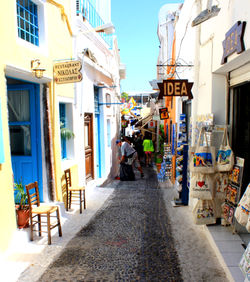
I grew up on a farm, and drove 3- and 4-wheelers long before I ever drove a car. In fact, my fun childhood memories have made renting ATVs while traveling one of my favorite activities. This one, however, had basically no power — it couldn't even do one donut, LOL. Many roads around Santorini didn't appear to have names, only arrows pointing toward a town, and fun "lost-in-translation" signs that I had to stop and photograph. The lack of road labeling might sound confusing, but I found it easier to navigate than in Fira, where I couldn't quickly translate any of the Greek street signs.
Lots to see out in the wilderness! I found a new sub-division of houses built to look like the iconic windmills found around Greece that were used to power flour mills. I followed signs to "Ancient Thera" up a mountain, only to find the site closed when I got there. The views down were amazing, though. There were dozens and dozens of tiny singular chapels spotted all over the island. I learned that paternal sides of Greek families all had their own chapels to worship in (and use as they please). I saw parched fields of grapes and tomatoes, and drove all the way to the bottom tip of the island to find views of everything above.
Walking is also a great idea on Santorini. You can walk from Fira to Oia along a stone path that follows the ridge of the caldrea. I also walked from Fira on the west cliffs to the beaches on the east coast, easily doable in a day. I walked those routes a few times, and if you have the time, you definitely should too.
My three weeks on Santorini were a dream. Freedom, friendship, fun in the sun. Get there. You'll love everything about it, too.
_______________
A FEW OF MY PHOTOS:
 |  |  |
|---|---|---|
 |  |  |
 |  |  |
 |  |  |
 |  |  |
 |  |  |
 |  |  |
 |  |  |
 |  |  |
 |  |  |
 |  |  |
 |  |  |
 |  |  |
 |  |  |
 |  |  |
 |  |  |
 |  |  |